Sunday, 4 April 2021

Low Traffic Neighbourhoods and the Packington 'leak'

Low Traffic Neighbourhoods

Since their initial introduction last year I have strongly supported the objectives of Low Traffic Neighbourhoods (LTNs):  Quieter safer streets, promoting and supporting active travel, reducing motrorised vehicle use, and reducing air pollution.  However, from the outset I was prepared to accept that the changes required to implement LTNs risk generating unintended consequences (and which is why they have been introduced under Experimental Traffic Orders - ETOs), and my position has always been that I am willing to support residents in resolving any of these unintended consequences, to ensure that LTNs only deliver the outcomes they are intended to deliver.


Unintended consequences

Two issues have emerged in St Peters Ward since the initial implementation of LTNs in June 2020:  

1 - A significant increase in traffic heading up Greenman Street. This is puzzling, since there have not been any changes in the arrangements of the roads in that area to cause this.  Highways officers are working on a plan to close off Greenman Street, but this will also involve some changes to banned turns into TFL controlled roads, which need to be agreed with TFL, which is taking time.  We are however, confident that the issue will be resolved.

2 - A route which bypasses the filter in Prebend Street has been seeing a lot of use.  The route is quite convoluted, as it involves driving through the one-way system in the Packington Estate and then the Arlington Square area, exiting onto Prebend via Coleman fields.  However, a lot of vehicles have been found to be using this route, some Satnav services are sending drivers this way, and recent traffic counts show it has lead to an 80% increase in traffic through the area and a recorded 85% increase in speeding.  We have also heard that some vehicles have been driving the wrong way round Union Square to bypass the filter in the opposite direction, which has lead to several near misses to date.

Both of these issues are unintended consequences, and are adverse and undesirable.  We have been pressing Highways officers for some time now to provide a solution to these issues, which we first became aware of quite soon after the LTN scheme was initially implemented.  Recent traffic counts have now provided firm evidence that there are indeed issues in both cases which need to be resolved.


Proposed solution

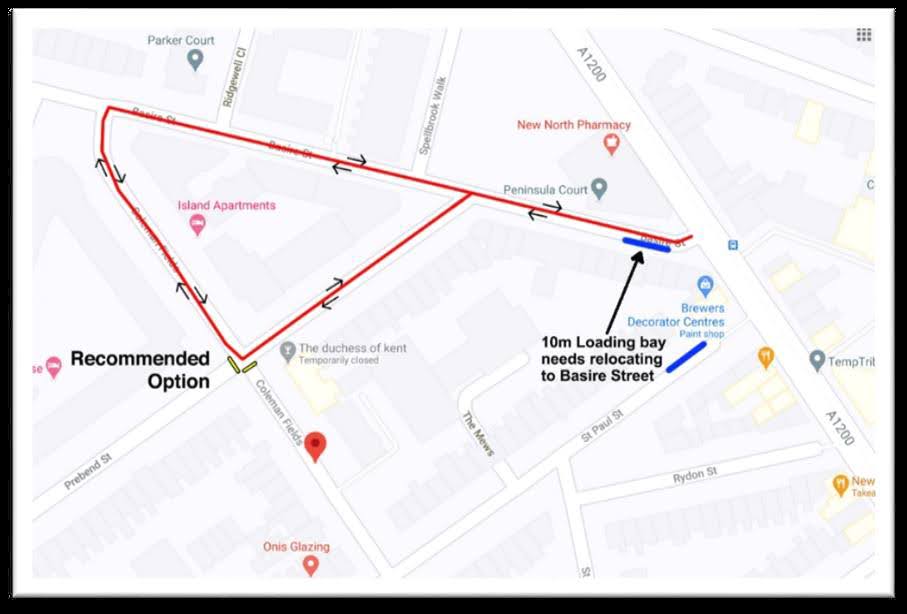
For the Packington 'leak', as it has been termed, the proposal is to move the filter in Prebend Street from the width restriction near St James Church to the junction with Coleman Fields, as in the plan below:


Coleman fields would be blocked on the South East side, with the filter on Prebend Street allowing local buses and emergency vehicles through, as is the case with the current filter.  The junction would look like this:


This change would result in most of the Arlington Square 'cell' being amalgamated with the St Peters 'cell', with access to this combined area via Packington Street, St Peters Street and Duncan Street, with the small area around Basire Street remaining as a separate 'cell' as shown on the map below:


This arrangement would also require the commercial servicing bay at the end of St Paul Street (mainly used by Brewers) to be relocated to the commercial pay-and-display bays on Basire Street.  This is unlikely to cause traffic problems, since there will be very little traffic using this very small area as a result of the changes to the filters.

Consultation 

Most residents will be aware that LTNs were originally introduced under an ETO, which allows for alterations to traffic management to be introduced on an experimental basis, with consultation to follow, once the changes have had a chance to bed in, and drivers have adjusted to the new arrangements. Local Authorities were advised by the Government to take this approach.  However, there has since been a court case brought by licensed taxi drivers, which has set a precedent that now requires a level of consultation prior to implementation, even for ETOs, and which makes somethign of a nonsense of the principle of an ETO.  

As a result of the court judgement we have therefore agreed with Highways Officers that there will be a consultation prior to making the change to the Prebend street filter, followed by a final full consultation on the overall St Peters Ward LTN as originally intended.


Timescales

The exact timescales for these two consultations have yet to be confirmed, but will be added to this blog as soon as they are known.


Monday, 19 February 2018

Local elections 2018 - What does a Councillor actually do?

A local Councillor is elected to serve and represent their local community, mainly in interactions with the Local Council, but also with other public bodies such as the NHS, TFL, Thames Water, and The Canal and River Trust, to name but a few.  Sometimes public opinion is clear about a particular issue, but sometimes there are views on both sides of an issue, and in these instances it is a Councillor's job to try and broker an agreement that is in the best interests of local people.

As a local councillor, I have a lot of contact with local community groups including attending Tenants and Resident’s Association meetings, the Neighbourhood Police Ward Panel, local schools, local action group meetings, and also via Ward Partnership meetings. However, I also meet people who don’t quite understand what a Local Councillor does, or who say they are “not interested in politics”, but at the same time turn out to have quite strong views about issues like messy recycling bins, noisy traffic, parking, diesel surcharges, sports and arts sponsorship, cycle lanes, and other things.

This blog is intended to give a bit more idea of some of the issues I deal with as a Local Councillor, and suggest why it is worthwhile being a bit interested in local politics.

Disabled parking charges: A constituent came to see me in my surgery, telling me that the housing association running the estate his mother lived on had been wrongly charging her for the use of a disabled parking space for her car for several years - it should have been free. He told me that he had tried to recover the charges, which amounted to nearly £2000, but had been told that a refund was ‘discretionary’. I contacted the housing association, and the money was then refunded.

Collapsed garden wall: A constituent who was a tenant in a street property contacted me and told me that her garden wall was at risk of collapsing. Her garden had been full of scaffolding for two years to prop up the wall, and that the repair works had stalled because the repairs department couldn’t get planning permission to do the repair. I contacted the repairs department and the planning department, got them talking to each other, permission was granted and the repair completed, including using proper bricks to repair the wall.

Tenant rehousing: A constituent contacted me to say that she needed to be rehoused to a ground floor apartment because of trouble with arthritis in her legs, but that she couldn’t bid for a different home because she couldn’t get the extra housing points for her disability. I contacted the Housing department on her behalf, the extra points she was entitled to were awarded, and she has now moved to a ground floor flat.

Welfare of vulnerable service users: A number of residents contacted me about three years ago, concerned about the welfare of service users being housed in a sheltered housing facility for men with mental health problems , and who had also been through the Criminal Justice System. The service users were supposed to be rehabilitating, but appeared to be using drugs, were sometimes seen drunk and incapable in the locality around the facility, and were also sometimes seen begging quite aggressively at bus stops nearby. I arranged with the management to set up meetings with the local community to discuss concerns about the service users, and for a time things seemed to improve. I have been attending most of the residents meetings. More recently I had been receiving reports from residents further away from the facility of similar behaviour, and gained the impression that matters were getting worse again. I have since involved the neighbourhood police who have been working directly with the management to mitigate instances of criminal behaviour, and I have also involved the licensing department, who have conducted training with the local off license to teach them to decline to serve people who appear unwell, or who seem drunk or otherwise influenced by substances. I also held a lengthy telephone review with the CQC, who register the facility, and who are also reviewing the services at the facility. I believe matters are now improving again.

Noisy Kitchen Extract: A constituent contacted me about the pub next door to her which was running what seemed to be a noisy kitchen extract, which she could hear whirring from her house and garden all day.  It was obvious from looking at the duct that it was a bodge-up. I obtained a copy of the planning permission which stated that the unit should not be making noise that could be heard from her property. Unfortunately the planning officer dealing with the case was not very helpful at all, and so I advised her to get her own acoustic report carried out to demonstrate that the unit was too noisy. After the report was completed, planning enforcement officers then visited the pub and required them to apply for a new permission for the unit, with conditions attached which set the noise from the unit at 5db below background noise levels, and with an additional condition, which I suggested, that the unit should be switched off if it breached the permitted noise levels. We are waiting to see if the unit will now be adjusted to make less noise, but the resident knows that the planning permission now includes a sanction that will get the unit switched off if the pub doesn’t comply with the permission.

Hanover school Lollipop Patrol: I was contacted by parents of children at Hanover Primary School, concerned about the safety of the many parents and children that have to cross Danbury Street to get to the school, because of the speed that traffic was travelling along the street at the most popular crossing point near the school. Parents were concerned that whilst there was a Lollipop Patrol at the junction with St Peters street, there was nothing at the junction with Danbury Street. I had a road safety audit carried out at the two junctions, and it turned out that the safety rating at the St Peters Street junction did not justify a Lollipop Patrol, but that the rating at Danbury Street did justify the Patrol. So whilst there was no additional funding to provide a second Lollipop person, we had robust justification to move the existing Lollipop Patrol to the other junction, where the Patrol was truly needed. However, the lady doing the Patrol found it much more challenging trying to stop the traffic on Danbury Street, as a number of drivers and cyclists were just ignoring her, which was quite frightening for her and for parents. I was aware that there was funding available from the Mayor of London for improvements to the 'Quiet Way' cycle routes, one of which goes along Danbury Street.  I was able to secure funding to introduce some pavement buid-outs at the junction with Noel Road, which has made it much easier for the Patrol to safely stop the traffic.

These are just a few examples of the kinds of issues that I have got involved in as a Councillor.  There are some more in the blogs below.  I hope you find these issues of interest.

Saturday, 20 May 2017

Cycle stands or Bike Bunkers?

I am extremely uncomfortable about the proposed introduction of so-called 'bike hangers' on Islington streets.  I am aware that we are already 'trialling' these structures in some areas of the Borough, but it is not clear on what basis they are being 'trialled' or what criteria are being assessed, other than the users of the structures being happy with them.

Whilst I appreciate that many people who ride bicycles live in apartments or up flights of stairs where it is not possible to store a bicycle internally, I do not accept that Bike Hangers are the only option for cycle storage on the streets.

For many years local councils have been providing cycle stands on public highways for public use, as well as motorcycle stands for motorcycle use.  These stands are provided for free on a 'first come first served basis', as they should be, for two-wheeled space-saving vehicles, and they are provided on the highway. There has been a recent significant increase in the number of public cycle stands being provided on the highway.

Well-used Cycle Stands in Hackney


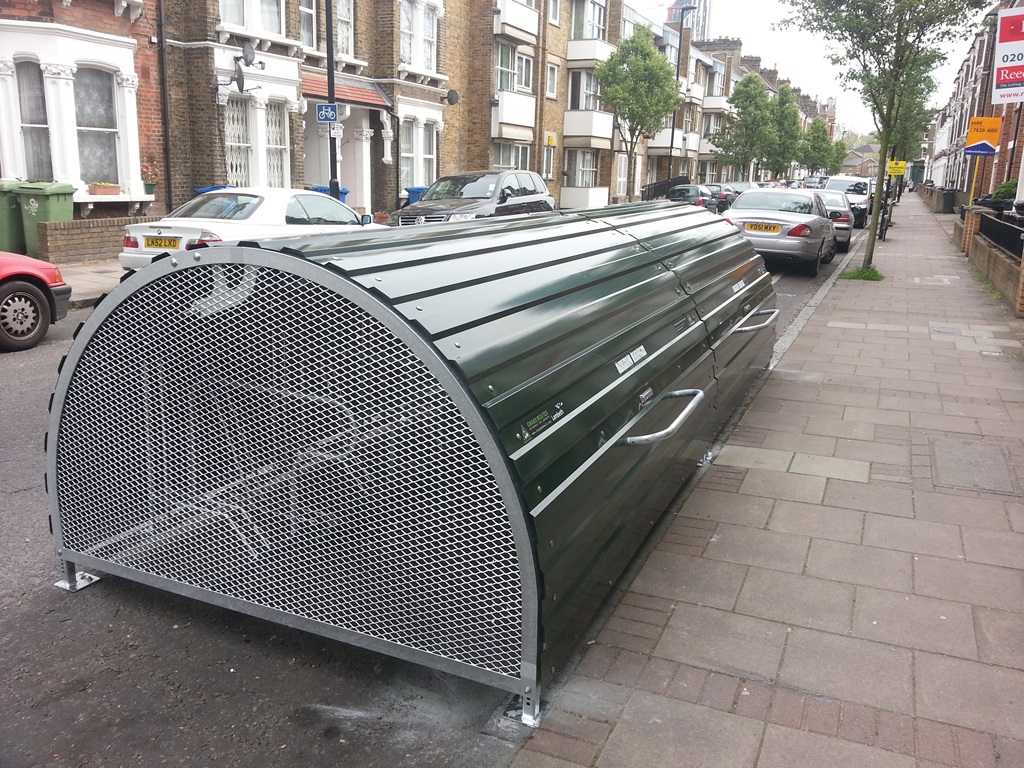
What I don't accept is that areas of the public highway should be enclosed for the exclusive use of individual members of the (cycling) public.  So-called cycle hangers are an unreasonable requisitioning of the public realm for individual use, are visually about as attractive as a prefabricated pigsty, I would have thought require planning permission as permanent structures, and also offer additional opportunities for crime by concealment and possible dumping.

A bike bunker taking up public highway space 

I strongly support cycling as a safe, environmentally friendly, and healthy means of transport, but I don't think there is any need for these pug-ugly structures, or justification for what I believe is illegally removing areas of public highway from public use, when a perfectly sensible solution exists which doesn't create either of these problems.

Sunday, 20 March 2016

What shall we do about Highbury Roundabout?

There seems to be a huge amount of discussion (and disagreement) about the proposals for Highbury Roundabout.

Taking the issues a point at a time; If there is one thing we can nearly all agree on, I think it is that gyratory systems are generally a Bad Thing, as they encourage traffic to travel at greater speeds, and are much more scary to cross.  They are also very scary for cyclists.  The classic example of this was Norman Foster’s interventions to Trafalgar Square, where a once scary racing circuit is now a much calmer, and more slowly-moving two-way traffic system, with the Northern arm pedestrianised, and Trafalgar Square completely redefined as a major public amenity and events location.

So, we can agree that closing an arm of Highbury Roundabout is almost bound to be a Good Thing.  But then the question is, which arm:  

There are strong and vocal supporters of proposals to close each of the four arms of the roundabout, all have whom have developed arguments as to why their proposal should be favoured.  I won’t go into the arguments here, but rather stick my neck out and say I think the current proposal to close the western arm is the right one, on the basis that the large majority of people movements in the area are associated with and gravitate towards the station, and that common sense suggests that this would be the most obvious link to join the central roundabout area to the public (ie pedestrian) realm, and would provide the best-used additional pavement area.

However, having reach this conclusion about arm closure, I am personally horrified at the amount of space traffic engineers have taken from the central roundabout area to remodel the roadway and cycleways.  The highway round the other three sides of the former roundabout is currently shown at six lanes wide, or seven, if you count the 2-way cycle route, which is far worse than the current racetrack round the roundabout.  This flies in the face of public amenity and common sense.  It is my impression that traffic engineers still see their role as trying to move traffic through an area faster, whereas I think most people would agree that traffic calming is what we need at busy junctions such as this - after all, that is the intended purpose of removing the gyratory.  

At the moment, the traffic scheme proposes to remove 27% of the central roundabout area and give it over to traffic movements. (If you zoom into the map, you can see in red the current outline of the roundabout.)  I think we have to push back on this, and demand that pedestrianisation be achieved without loss of the valuable green space that is the roundabout itself: In a Borough with so little green space it seems wrong to lose such a large amount of that green space in the name of  maintaining traffic flows. 

I also have my doubts about the merit of introducing quite so many cycle lanes, when the route one would have to take on a bicycle is in several directions quite counter-intuitive.  Looking at the proposed layout, and imagining what I might do if I wanted to travel from Holloway Road to Upper street on my bike, I would probably opt to just stay on the road rather than criss-cross over the various convoluted cycle routes.  In my experience most cyclists tend to take the most direct route rather than follow cycle paths that take longer.  The cycle routes need to be logical and straightforward, or some cyclists may take matters into their own hands and start using the western (pedestrianised) arm as an informal alternative route, which I'm not sure would be the best solution either.

And then finally, there is the discussion about whether to remove the railings around the Arboretum, (so-called because it is a collection of various tree species, originally planted as an experiment in 1959, to investigate the resistance of various tree varieties to exhaust fumes).  Again, personally, I think the railings should be removed, or we won’t get the benefit of a major new public open space, and the rebalancing of the public realm between motorised vehicles and everyone else.  The removal of all the railings on the Angel section of Upper Street a few years is a good demonstration of the success of this rebalancing principle.  However, I do think a lot more discussion is needed about how we landscape the central area so that it can take the wear and tear of being a public open space.


Overall, I think we should commit to closing the western arm, push back on the loss of the green space at the expense of traffic, revisit the cycle lane proposals, and keep talking about the use of the central area.

Sunday, 31 January 2016

Green waste and food waste recycling

I have received a number of emails from residents in my ward concerned about our proposal to stop doorstep collections of green/garden waste and also food waste.  (To be clear, co-mingled mixed recycling collections (paper, plastic, metal and glass) will continue unchanged, as they are collected by the same vehicles that collect general waste.)

We do not make decisions like this lightly.  However, in a situation where we have had more than 50% of our support grant from Central Government cut over the last five years, we are running out of areas where we can make savings via efficiency, or cutting less efficient services.  As a result of stopping this collection service we will achieve a budget saving of £1m, which would otherwise have had to be cut from areas such as youth services (which we have chosen to enhance this year), libraries or the voluntary sector.   


Food waste will be collected by positioning dedicated food waste bins in up to 150 locations in each ward across the borough, with sensors to alert the Council when they are nearly full, for optimal efficiency of collection.  The food bins will look like this:


The options for garden waste will be:
  • Take the waste to the Hornsey Road Recycling Centre
  • Use a communal collection point in the locality
  • Pay to have the waste collected by the council.

       Garden waste collection bins will look like this:


These new arrangements for green waste collections have been trialled in Tollington Ward over the summer, and reports are that recycling rates have not suffered as a result.  There does however remain the question of where the communal recycling points will be located, and the risk that they may become a sort of general dumping ground for rubbish.  I am still waiting to hear how the locations for green waste collection points will be established, and whether there is a maximum distance criteria for this.  With regard to assisting disabled people, the council already provides support for residents with mobility difficulties, and this will be expanded to include green waste collections for those residents.

I realise that some residents are not very happy about this proposal, and I can understand why this is causing concern, but the harsh reality is that the Tory government’s cuts to local authorities are really starting to bite, and we won’t know if this is an effective (ie positive value) cut unless we try it.


Sunday, 13 December 2015

Suspension (and re-opening) of the LUTS (Lower Urinary Tract Symptoms) clinic.

As the Chair of Islington’s Health and Care Scrutiny Committee, and Vice-Chair of the North Central London Joint Overview Health Scrutiny Committee - JOHSC (which covers Barnet, Enfield, Haringey, Camden and Islington), I first became aware in early November of patient concerns about the possibility of closure/decommissioning of a specialist LUTS clinic, which is run by Professor James Malone-Lee from a medical centre in Hornsey, and commissioned by Whittington Health.  Anxious patients asked to attend the December meeting of the JOHSC to make a deputation to the committee to express their concerns.  It seems that professor Malone-Lee has been using a regime of prescribing higher strength, longer-term antibiotic treatments than is usually considered acceptable under NICE prescribing guidelines to treat the patients' symptoms. The key point in all this is that the patients have all tried many times (and failed) to get their symptoms cured under more conventional treatment regimes, and had been referred to Professor Malone-Lee’s clinic as a last resort. Many of the patients report that this regime has worked for them where all others had failed.

We were in the process of organising to take the deputation when I received a phone call from Simon Pleydell, Chief Executive of the Whittington, telling me that they had taken an urgent decision to suspend the clinic following two episodes of related patient harm.  The Whittington said they would be making alternative arrangements for patients, but this didn’t seem to transpire.

As soon as the announcement was made, I started receiving long, anxious emails from patients, all of whom wanted to talk quite candidly, and in some detail, about their symptoms, and to relate how the professor’s treatment had been the difference between a life of almost unbearable discomfort, and a semblance of normality.  I personally received over 50 emails from patients of the clinic, all surprisingly detailed, and with a very similar story, and ending with the distress and anxiety they were all suffering at the prospect of not having their prescriptions renewed, and a return to their suffering.

What followed was a combination of intense lobbying of the Whittington, and myself, and also Cllr Alison Kelly (Camden) Chair of the JOHSC.and Cllr Pippa Connor (Haringey) vice chair, by a very determined group of patients.  I had a number of conversations with the Whittington during which I suggested that, given the patients’ clear understanding of the risks of the treatment, and that they considered this risk worth taking, that the clinic should be re-opened on the basis of an agreement with patients about the risks, perhaps some kind of disclaimer similar to that used with cancer patients.

The Whittington then held a meeting with patients, whilst at the same time a group of patients took the issue of the closure to court.  The Whittington seemed generally chastened and surprised by the strength of feeling, and the loyalty of patients to the clinic.  Shortly afterwards, an agreement was reached with Prof Malone-Lee to a lesser restriction on his prescribing and for a full independent review of the clinic and it’s practices to be carried out, following which the clinic was re-opened.

About a week later the JOHSC took the deputation, and after about an hour’s debate, we arrived at a series of recommendations to ensure that the independent review of the clinic is properly carried out, and that patients would be protected meanwhile.  The recommendations, as agreed by the committee are as follows:

Recommendations:
1.    That the Committee be minded to consider any proposal to decommission the LUTS Clinic by local CCGs as a substantial variation to services and that the issue be referred to the Secretary of State should such a proposal proceed without comprehensive consultation on the grounds of failure to consult.  

2.     That the committee be given the terms of reference for the external review of the LUTS clinic, that the terms of reference of the review should include the Whittington’s actions leading up to the suspension of the service,  and that the results and recommendations of the review be presented to a future meeting of the committee prior to any further decisions being taken to decommission. 

3.     That the Committee be updated with the Strategic Risk Register from Whittington Hospital and that the communications and engagements strategies and responsive action plans are shared with the Committee, to satisfy the committee that appropriate arrangements are in place should similar circumstances occur in respect of any future urgent actions by the Whittington.

4.     “That letters be sent to both Haringey and Islington CCGs requesting confirmation that they will not be proceeding with their proposed decommissioning of the LUTS Clinic pending the outcome of the Independent Review.” 

Actions:
In relation to the level of treatment and the prescriptions that were carried out at LUTs Clinic, Councillor Pippa Connor, requested that the Committee receive an update on whether any medical studies or reviews were undertaken by UCL about the treatment provided to patients.


I appreciate this is a very abbreviated version of events, which excludes a number of details.  However, I think the most important issue is to get the committee’s recommendations published as soon as possible, since with regard to protecting patients’ health, the recommendations are aimed at protecting them in the short-term as well as the long-term, and I want patients to have the recommendations to hand, should discussions arise with either the Whittington, Prof Malone-Lee or UCLH, with whom the Prof carries out his research. 

Sunday, 6 September 2015

The Sun always shines on The Angel Canal Festival

Vivien, Lloyd, myself, Graham and Muhammad on the Labour
Party stall.

Myself, deputy Mayor Kat Fletcher, Youth Council member Zen,
and Brian Voakes, chair of the Angel Canal Boat Trust on our
way to the Festival.
Once again the canal festival had the luck of the gods.  The sun was peaking through at 9 o'clock, and by 4 in the afternoon was baking hot, and the Festival was heaving with people.

I had a particularly good start to the day having been invited to join the Deputy Mayor for a VIP trip from the Canal Museum, through the Islington Tunnel to City Road Lock for the opening ceremony of the festival, and then on to Islington Boat Club for some races.  It was great to meet Brian Voakes, the Chair of the Canal Boat Trust, and hear about the work they do with taking deprived children on 5-day canal adventures on the Angel 2 boat, and the team-building and environmental awareness this gives to the children.  And also, to hear about their expanding work with early dementia patients, who they help to stimulate with drawing, singing, and opera singers in the tunnel!

We arrived at City Road lock and Kat Fletcher gave an excellent welcoming speech, making particular reference to Crystal Hale, who started the Trust, and who successfully campaigned to prevent City Road Basin being filled in and built on.  -  It seems unthinkable now.

Moving on to our stall on Danbury Street Bridge, we collected over 300 signatures to our petition against government plans to force the sell-off of 'high value' council properties when they become vacant (most of the council homes in Islington will meet the governments proposed threshold market value of £400,000 and would have to be sold).  This hideous policy would drastically reduce the amount of social housing available in Islington, and eventually, remove it completely, resulting in draconian social cleansing in the area.  Generally it took less than two minutes talking to people to convince them that this is a completely unacceptable policy.

We also had some useful conversations with residents on other topics, such as the current consultation on changes to the CPZ rules.  Most local residents are either against or sceptical, and even John Ackers from ICAG broadly agreed with my position.  We also talked about other housing issues, air pollution on the canal, antisocial behaviour, phone thefts, more general discussions about the London housing crisis, and the vulgarity and inappropriateness of the tower blocks going up at the City Road end of the City Road Basin.

It was a great day, we met people from many of the strands of our community, and it made me feel really good to be a ward councillor in St Peters.

Monday, 31 August 2015

Has the Council got the parking wrong? - Clarification

Since I first published my blog about the current CPZ consultation I have been lobbied by a diverse group of interested parties, including local businesses, residents, charities, and environmental campaigners. The following hopefully clarifies the approach I am taking on this issue:

My current position is based on views put to me by constituents and other interested parties, including local businesses, on whose behalf I am trying to raise the level of debate, focussing on whether the proposals make sense, and whether, if implemented, they might have different outcomes to those suggested by the consultation. The consultation documents suggest, for example,  that the proposals will make it easier for residents to park.  It has been put to me that they may not, and that they may also have a harmful impact on local businesses, markets, local charities, and the wellbeing of older and more infirm people who rely on visits from others, often made by car, and for whom the new visitor arrangements could well be sufficiently complex to discourage visitors.  

It is a complex enough discussion to try and establish if the outcomes of the proposals will be as intended, especially given that there seems to be very little empirical evidence to support them.

If we start trying to debate the wider issues, such as the merits or demerits of parking controls in terms of the impact on the environment, whether these controls might encourage or discourage car use, whether controls are intended to reduce car usage or simply regulate parking, whether they make the environment safer or not, and whether we can afford to assume that all private car use is inherently bad and should be discouraged, the debate will unravel completely, which is why I am not attempting to address any of these points.  

For the moment, I am simply reflecting and representing what seem to me reasonable and reasoned views that have been put to me regarding the current consultation, as any Councillor should.  

Sunday, 9 August 2015

Has the Council got the parking wrong?

Islington Council is currently consulting on changes (ie extensions) to the Controlled Parking Zones (CPZ) in five areas of the Borough.  The Council is arguing that in the case of the Arsenal matchday zone, the changes will eliminate confusion about which days there are restrictions in place, and in the case of zone 'B', that it will make it easier for residents to park in the evenings.

I have been contacted by a number of residents and businesses with comments about the proposed changes which make me think that the changes may not have the intended outcomes.

In the Matchday and zone B areas, residents say that at the moment, if they arrive home in the evening and there are no resident's spaces, they can simply park on a yellow line nearby, and then move their car to a space in the morning, which works quite well. With the proposed changes, residents would be forced to find a free resident's bay, which could involve a significant amount of driving around looking for a space, or  risk getting a parking ticket.  Also, in zone B, where the proposed hours would be different to the adjoining zones, there would be a greatly increased chance of residents accidentally getting a ticket for parking in a Zone B street after 6.30, or on Saturday afternoons and Sundays, which introduces a similar type of confusion to that which the proposals are trying to remove in the matchday zone.

Local businesses are also extremely concerned about potential harm to trade of the zone B restrictions, since it would oblige all customers visiting the area to find a legal space or get a parking ticket, as single yellow lines would be out of bounds. The Council says that the charge to park in a parking space would be only £2.40, but this doesn't take into account the hassle of trying to find a legal space, which risks putting a lot of people off coming to the area.  Also, particularly worrying is the possibility that both traders and customers of the Sunday Farmer's Market in Chapel market will be driven away by both the cost of parking and not being able to legally park near enough to the market to make trading or shopping viable. Some residents and businesses have also expressed doubt about the motive for holding the consultation over the summer holiday period, and have also questioned whether there is any empirical basis for the proposals, rather than just one person's view against another's over whether the impacts will be positive or negative.

It seems to me quite possible that these proposals would make it harder for residents to park, increase the likelihood of accidental parking tickets, and also damage local businesses, including the real possibility of killing off the Farmers Market, none of which would benefit local residents.

I would urge as many residents as possible to respond to the consultation before it ends on 7th September.   (Google - 'Islington Parking Consultation')

Sunday, 29 March 2015

Is the 'Mansion tax' a good idea?

Firstly, the name is wrong.  (It was the Lib Dems’ name before Labour got hold of it.)  The word ‘mansion’ in this context is a pejorative term, smacking of the envy of ‘rich’ people.  A divisive ‘them and us’ attitude, which is not a sound basis for introducing a new tax, especially not a tax from a socialist party that is supposed to treat all as equals.

But if we get beyond the name, we need to be sure what we think it is intended to achieve:  

I am very concerned that a tax based on the current 'value' of properties could well hit many people who have lived in an area for years, who happen to own a house that has gone up in value by a factor of 10 or more, who are not necessarily rich themselves.  People who could not afford to pay the tax, who are mildly insulted to be suddenly told their home is a 'mansion', who do not aspire to that type of lifestyle,  and in a lot of cases, in Islington at least, are Labour supporters.  Knight Frank report that eight out of ten homes likely to be hit by the Mansion Tax are situated in Windsor, Sevenoaks, Islington, Wandsworth and Guildford.  Some Labour and Conservative MPs are concerned that the tax will hit “cash-poor homeowners, rather than rich overseas investors”. The tax in its present form is targeted at the wrong people.

I would argue that the main purpose of this tax, which should bear the neutral term ‘Property Tax’ should be, obviously, to raise some more revenue from those that can afford it, but that it should also be structured in such a way as to try and counterbalance rocketing property prices, particularly in London and the South East.
 
A recent commentator from the financial sector stated that he thought the London property market has become completely decoupled from the basic market functions of supply and affordability.  The London property market has become its own investment market, that has floated free from the low interest and low-inflation economy that is otherwise the current economic climate, and has become, in the words of Andrew Neil, a “global reserve currency”.  This situation is driving away ordinary people who want to live in or around the city, both aspiring buyers, and anyone trying to rent.  There can often be a big difference between the means of those that can afford to buy into the current market, compared to those that have lived in an area for years, and live there because that’s where they like to live, and not because they want to make money out of their homes.
  

I think the Property Tax should be based on a similar system to that in New York State, where the tax is levied as a percentage of the value of the property, but with the difference that the ‘value’ of the property should be based on the most recent price paid for the property, not a valuation.  This approach has the advantage that there can be no arguments about whether a property is correctly valued, since the price paid is the best valuation you can get.  It will not require valuations to be carried out, because the information will be readily available from the Land Registry.  And assuming that the tax is set at the right level, it will hit those that pay high prices hard, and not those who paid significantly less and just happen to be caught in the price spiral.  This should have an immediately deflationary effect on house prices, as purchasers will be thinking hard about the ongoing cost of owning a property if they pay too much for it, since they are effectively setting their own tax bill with the offer they make for the property, and it will ensure that only those that can really afford the tax have to pay it.  

Crossrail have still got it wrong

The Crossrail safeguarding proposals have recently been adopted into legislation, which means that the ‘safeguarded’ route consulted on in late 2014- early 2015 is now legally safeguarded, along with the “areas of surface interest”.  Which means that Crossrail/TFL/DFT can now continue with developing their plans to bulldoze large sections of the Angel.  

It seems that the level of protest at the public meeting I publicised in January has had some sort of effect, as the much loved Co-Op Bank Building has now been removed from the proposals, but the remainder of the block is still identified for demolition.  There is also talk that the RBS building is being reconsidered for the surface works site, but there is still a determination to build the actual station entrance on the west side of the High Street.  This is fundamentally wrong-headed.

Whilst the removal of the Co-op bank building from the site is a step in the right direction, it does not change the fact that a station entrance on the west side of Islington High Street will still destroy a number of listed buildings to make way for the railway, and it doesn't change the fact that Torrens street, as well as containing buildings of significant historical value, is also a completely inappropriate site, due to access issues and proximity to residential properties. 

Only the use of the RBS site for both the surface works and a new station entrance will actually deliver real regeneration to the area, which is what Crossrail is supposed to do.   

We need to continue to campaign for a solution that actually benefits Islington,  And that includes campaigning for a ‘metro; rail type solution, which would be less disruptive and destructive, and allow more flexibility of route and scope for new stations. 

Sunday, 25 January 2015

What's happening at Owen Street?

Everyone who cycles or walks through Owen Street from Goswell Road to St John's Street would agree that the conflict between cyclists and pedestrians is a ridiculous situation:  Cyclists are directed to ride on the pavement, causing alarm and distress to pedestrians, not to mention the occasional fisticuffs.  Why is this?

The problem is, when the Virgin Leisure Centre was built around 2000, the road that passes along by the building was private, and for some reason, the Council at the time (under the Liberals I believe) agreed that it should stay private, with the result that the pavement on the side of the road between Owen Street and Owens fields was the only part of the road that is public highway.  (I should add that once you bump over the awkward dropped kerb shown in the pic above, the rest of the roadway leading up to St John Street is all public highway.)

The consequence of this loopy legal arrangement is that the Council is unable to direct cyclists onto private property for fear of being held liable if an accident occured, and so was forced to designate the pavement as a cycle track, with the dangerous and scary consequences that everyone is familiar with.  

Since 2007 I have been making attempts to try and either get the road adopted, or get an agreement for cyclists to use the roadway, and every time I have been told that the owners of the property would not agree to it.  I persisted however, and finally one of the Council's senior legal officers discovered that we had been dealing with an agent for the residential properties on the site, and not the Freeholder.  Legal officers then managed to contact the freehold owners of the site, who I believe are The Brewers Company, who were much more amenable to the idea of improvements to the operation of the highway in the interests of public safety.  

The freeholder has I gather, now agreed in principle to allow the use of the private road by cyclists, legal documents have been exchanged, and lawyers are now working on the final details, such as who owns the drains, and where the water goes when it runs off the Council's pavements into the freeholder's drain, and whose responsibility the drain is as a result etc (yawn).  Once this is sorted, the Council will change the road and pavement layout in the area shown in the picture, so that cyclists have a straight run through, and the pavement will become pedestrian-only, as most reasonable people might expect.  

We might even see the work being done this year, which would be great.

Sunday, 28 December 2014

Does Islington need Crossrail 2?

You might have noticed that the Government are currently consulting on certain aspects of Crossrail 2.  (See the plan above showing the proposed route - zoom in if you need to.)  What you may not realise is that irreversible decisions are being made NOW about the type of railway this will be, where it will go, and which buildings will have to be demolished to make way for it. 

The railway was originally planned about 20 years ago as a new tube line, called the ‘Chelsea-Hackney’ line.  Since planning for HS2 was commenced, it was realised that existing rail connections at Euston are very poor for connections to the proposed new high speed regional service when it arrives at Euston.  It was therefore decided to divert the Chelsea-Hackney line to stop at Euston.  Then it was decided to make the Chelsea-Hackney line a ‘Regional’ type service, not a metro Tube type service, connecting to the whole East of England rail network.  This means longer trains, more vent shafts, much more major infrastructure both above and below ground, far more major disruption at surface level to construct the railway, and far less flexibility in terms of where the train stops, and how many stops there can be.

The current consultation is called the “safeguarding” consultation.  What this actually means is final decisions being made now on the type of railway, the route of the railway, where the stations will be, and which buildings will be lost.  In Islington this means a single stop at Angel, with all the buildings on the west side of Upper street from Angel to White Lion street being demolished, including the CO-OP bank, to make way for the station entrance, and the whole of Torrens Street being lost for vent shafts.  There will also be a major construction site at Penton street on the site of the public carriage office.  The platforms will run all the way from Angel to Penton Street.

Crossrail claim on their web site that “over 80% of respondents favour a regional option”.  However,  I very much doubt that a survey of areas such as Islington, which will be most disrupted by the construction and most poorly served by the resulting railway, would return a response in favour of regional trains.  It’s a bit like asking all the people that live outside London whether they would like a new motorway through Islington to help them get into town more quickly.  A metro Tube type train service would, in my view, serve the needs of Londoners much better, and would allow for much-needed new stops at Essex Road, and Old Street, both areas which would actually benefit from improved connections.

I would urge everyone to respond to the consultation, which is available on the internet at 

https://www.gov.uk/government/consultations/crossrail-2-safeguarding-directions 

The consultation closes on 29th January.   There is also a public meeting being held at the Town Hall on Tuesday 13th January at 5.30pm to discuss the consultation, and I would urge as many people as possible to attend and express their views.

Sunday, 3 August 2014

Why is Vincent terrace canal-side walk still closed?

There has been much public outcry about the closure of the Vincent Terrace canalside open space.  Many residents have said forcefully that they use and enjoy the space, and that in a borough with so little green space it is highly valued, and a great area for children and dogs to go exploring.

Many people want to know why, when there is such significant support to reopen the gardens, that the Council has not re-opened them yet.

The space belongs to the Canal and River Trust (CaRT).  Islington Council held it on a 42 year lease which expired 2 years ago.  Negotiations to renew the lease stalled, and CaRT locked us out earlier this year.  Council officers believed (wrongly) that the space was little-used, and thought it best to relinquish the space.  I circulated this view to residents, which generated the outcry.

Since officers understood that the space is used and needed there has been some dialogue with officers over what the costs would be to carry out any repairs to the space to make it safe for the public to re-enter.  These costs are now at an acceptable level.  This was followed by negotiations with CaRT to agree the terms of a new lease with them.  There were a number of contentious issues that needed to be discussed, relating to which elements of the space the Council would be responsible for maintaining, and also some planning issues. 

We have now reached agreement with CaRT on these terms, which include a new long lease on a peppercorn rent, with the Council responsible for maintenance, including trees. 

We need to lease to be signed, in order for the Council to get access to the area to carry out the necessary repairs, after which the space will be re-opened. 

In the mean time I have heard it reported that the gates have broken open and trespassers entered the site.  The Trust are aware of this, although I’m not sure what action they have taken to secure the area. Some local residents are also trying to keep the place tidy, and trim back some of the overgrown shrubs.  It would be good to get some proper community gardening going in the space once it is reopened.

Friday, 18 April 2014

UNION SQUARE REOPENED

Union Square next to the Packington Estate had been a bit of a dive for years.  It had been one of Islington's original Garden Squares, but when the Packington Estate was first built, the road on the Packington side was swallowed up into the estate, and Union Square became somewhat overshadowed by the Estate, overgrown and underused.

Now the Packington redevelopment is well under way, the new design for the estate has reinstated the road all the way round the square, and even includes a terrace of pastiche georgian houses which look so much like the originals on the other side of the square that you have to blink hard to see the difference.  There was also included in the redevelopment agreement a chunk of money to refurbish and improve Union Square.

A lot of people were asking me what was going to be done about the square, and when and how the money would be spent.  So I contacted the Council's Greenspace department, and set up a meeting with as many local people and stakeholders as I could find, to try and find out what people wanted in the park.  There were some interesting and wide-ranging discussions, including whether the water feature should be retained, whether there should be gates along the sides of the park, whether dogs should be allowed in, whether there should be childrens' play equipment, and whether there should be a central activity space.  Several consultation events were held, and the views of everyone who attended were fed into the brief.

Greenspace tendered the design work, and local Landscape Architects 'Breeze' were selected.  I attended briefing meetings with Breeze, and fed back to them views that I was receiving from residents as the design process progressed.  Further consultation events were held, where three design options were shown by Breeze.  There was strong agreement amongst residents about which option was best, and that is what has now been built.

And on 12th April, the Mayor of Islington reopened the square, with a community planting event following on after (ably assisted by the advanced trowel-handling skills of Gordon McArthur of the Arlington Association).  It was a bit of a bumpy ride getting to the final design, and getting agreement on what was in and what was out, but the outcome is quite extraordinary, with a whole new spacious, light, airy garden square open to residents, and loads of kids playing in there, using the paths for scooter racing.

A very satisfactory piece of teamwork between Residents, Local Councillors and Greenspace officers.  The Picture shows the Mayor of Islington, Cllr Barry Edwards, St Peters Ward Councillor Alice Perry, myself, and a number of local residents who were actually doing the hard work of planting the plants.


Interview with London Hospitals Campaign

I was recently interviewed by the 'London Hospitals' campaign, which attempts to keep track of hospital reconfiguration across London.  I think they are doing important work, as the pace of change in the Health Service at the moment is hard for anyone to keep up with.

The interview can be found at the other end of this link:

http://londonhospitals1314.wordpress.com/2014/03/30/exclusive-interview-with-islington-councillor-martin-klute/

Thanks to Jenny McCall for the time she took to give a thorough and balanced interview.

Monday, 20 January 2014

Is there an election on?


Actually there will be.  On May 22nd.  And St Peters Ward Councillors are already out on the campaign trail.  We had an excellent weekend's sessions on Saturday and Sunday afternoon, with support from  (l-r) Cllr Paul Smith, Jenny Kay (aspiring Mildmay Ward Cllr person), me at the back, Cllr Alice Perry (the human dynamo), Newell from Holloway, MEP hopeful Lucy Anderson, and Cllr Richard Watts, Leader of the Council.  You can't see Cllr Gary Doolan, because he was holding the camera.

Support on the doorstep is very good, but we also met several people who are being hit by the bedroom tax, who just don't know what to do, and are afraid of being driven out of Islington altogether, where they have lived for most of their lives. We referred them to Islington's Benefits Advice Line which we set up to try and give the best possible experienced help to people in this kind of situation.  It is hard not to see the Tory Government's benefit reforms as pretty vicious social cleansing of our inner city areas.

Sunday, 12 January 2014

Cycle safety on the New North Road

The new improved cycle lane access into Arlington Avenue

It has been a long-standing campaign of mine to persuade cyclists in a hurry to use alternative routes to the canal towpath, where it is well-known that a small number of speeding cyclists are terrorising more peaceable users of the towpath: Pedestrians, parents with kids and buggies, older people, and recreational cyclists.

There are good cycle routes all the way through Hackney, and the Arlington Avenue area in St Peters ward is quiet and safe.  The big obstacle is the New North Road.  We need traffic signals outside Gainsborough Studios, which is in Hackney, and we need better permeability into St Peters side streets.

This week I have finally succeeded in getting Islington’s highways department to improve the turning into Arlington Avenue. Previously, the turn into the cycle path was so sharp that cyclists were forced to swing out into the middle of the road to make the turn, pushing them into the path of speeding cars and lorries coming up behind them.  At my request Islington Highways have now installed a smoothly curving kerb to the cycle lane, making it possible to turn into Arlington Avenue safely, and without having to swing out.


This is one small, but important part of the jigsaw to create safe alternative routes for cyclists, so we can restore safety,  peace, and tranquillity to the towpath.  Now we need Hackney and TFL to install traffic signals at Gainsborough.

Sunday, 8 December 2013

Chicanes on the towpath

I don't know how long I have been arguing for chicanes on the towpath that actually slow cyclists down - and in response the Canal and River Trust have been saying they would rather 'educate' cyclists to slow down.

So imagine my surprise, when exploring the Camden side of the tunnel, to find that there already is a chicane that does exactly what I have been saying they should do.  And here it is.  3 prongs, and a tight enough dimension between them that you have to seriously slow down to get through it, but it doesn't stop wheelchairs, or buggies, or tricycles.  You just can't physically pass through it at any speed on a bicycle.

If CaRT can provide this on the Camden side, why can't they do it on the Islington side, where cycling pressure is at its greatest?

Thursday, 28 November 2013

Motion to Islington Council on Canal Management

Below is the text of the motion to Islington Council identifying the canal management issues that impact negatively on the Borough of Islington.  This motion was passed unanimously, supported by all elected members of the Council across the chamber.  

"This Council notes:

Under Government reforms, British Waterways became the Canal and River Trust (CaRT) – a charity that owns and operates England’s inland waterways and infrastructure. The Regents Canal and towpath run through the borough of Islington, passing through St Peters and Caledonian wards, and in these urban areas the towpath passes very close to people’s homes near the canal. Access to the canal and towpath is controlled by CaRT and is not a public right of way.

Since the Trust took over the running of the canal, there has been a sharp increase in problems with speeding cyclists on the towpath, failure to keep the bins emptied, from noise and air pollution coming from Canal boats moored on the banks of the canal, and congestion from double and triple mooring in built-up areas. The CaRT has been very slow to respond to these problems, and when they have, they have largely failed to make any difference, or they allow different standards to operate on different parts of the canal for no obvious reason.

We call on the Council:
• To work with CaRT, TFL and London Borough of Hackney highways officers to achieve safe alternative cycle routes for cyclists in a hurry, and to introduce cycle calming measures on the towpath that force cyclists in a hurry to slow down.

• To bring legal pressure to bear on CaRT to ensure that the Towpath is kept clean, the bins emptied 7 days a week, and an acceptable standard of public hygiene maintained.

• To bring legal and moral pressure on CaRT to enforce higher environmental standards on the owners of canal boats, to reduce noise and air pollution from noisy generators, and to require boaters to burn only smokeless fuels, and to set up mechanisms to enforce these standards.

• To lobby for changes to the Clean Air Act to include the waterways.

• To bring pressure to bear on CaRT to enforce their own mooring rules.

• To cooperate with CaRT to erect new joint CaRT/LBI signage on the towpath making clear what are the environmental and mooring rules.

• To commence joint working between the Council and CaRT to establish ways of legally enforcing compliance with these rules.

This council further notes:
• CaRT is the owner of the canals, and needs to take full responsibility for the behaviour and actions of people using the canal and the towpath, and for the environmental impacts of that activity. "